This post contains affiliate links. As an Amazon Associate I earn from qualifying purchases, at no extra cost to you.
We did not set out to build a spa. We set out to fill a stock tank with water so the family had somewhere to cool off in the backyard. What we ended up with is a 1,000 gallon wading pool that sits at 94 degrees, stays clear without a daily chemistry lesson, and did not turn our power bill upside down.
Three purchases did most of the work. Two of them make the water worth getting into. The third is the one that makes you want to stay out there once you are in. None of them took more than an afternoon to set up. Here is exactly what we bought, how the install went, and what the results have actually looked like.
First, a Fair Warning: This Is Not a Finished Project

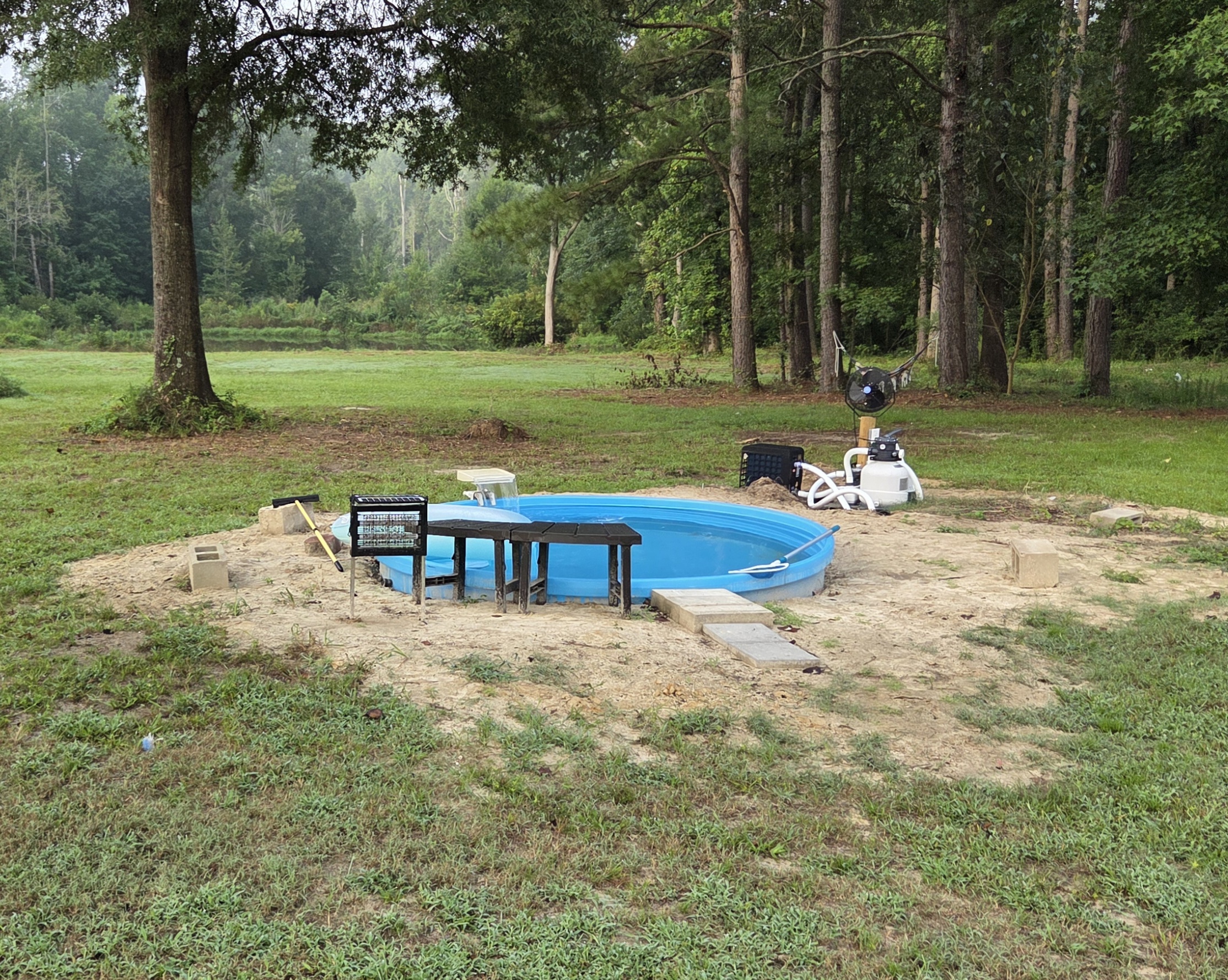
That is the pool as it actually sits in our yard right now. Not staged. Not finished. I could have waited until everything was pretty and then written this, but that is not how any real backyard project goes, and it is not how we do things here.
Here is what you are looking at. The tank is in and full. The filter is running, off to the right. The fan is up on its post. The heat pump is doing its job. Everything past that is still in progress. The base around the tank is bare sand and a few blocks. The platform along the edge is temporary, and it is going to be replaced with a proper deck. The landscaping has not been touched. There are pavers laid down as a walkway because we needed a walkway that day.
The equipment side of this build is done and working, which is why it is worth writing about now. The rest of it is going to take the rest of the season.
We are filming the whole thing as we go. The deck build, whether the sand base holds up through a wet season, the mistakes, and whatever we end up tearing out and redoing. If you want to watch a backyard project happen in real time instead of seeing the after photo, that is all going on our YouTube channel.
Follow the build: Real Life with the Larreaus on YouTube
The Setup We Are Working With
Our stock tank holds roughly 1,000 gallons. That number matters, because both of the water units are rated for pools several times that size. Running equipment that is oversized for your water volume is the whole reason this works as well as it does. The gear never has to strain.
If you have a smaller tank, say 300 or 500 gallons, the same equipment will still work. It will just get you to temperature even faster.
1. The Heat Pump: MICOE 18,000 BTU Pool Heater
MICOE 18,000 BTU Pool Heater for Above Ground Pools
This is the piece that changed the whole experience.
What it is
It is an 18,000 BTU heat pump rated for above ground pools up to 5,500 gallons. It runs on a standard 110 to 120 volt household outlet. It has a titanium heat exchanger, a touchscreen on the unit, app control from your phone, and it does both heating and cooling. Rated COP is 4.88 and it runs at about 50 decibels.
That last part is worth sitting with. A heat pump does not burn anything to make heat. It moves heat out of the outside air and into your water, the same way an air conditioner moves heat out of your house. That is why the efficiency number is so high and why the electric bill stayed calm.
Setting it up
This was the part I expected to be hard. It was not.
The unit came mostly assembled. It sits on a flat spot near the tank with clearance around it so it can breathe. You connect the inlet and outlet hoses so the water loops from the pool, through the heat pump, and back. Then you plug it into a grounded outlet.
Plan on an hour if you take your time and route your hoses neatly. There is no gas line, no propane tank, no electrician, no permit. If you can assemble a grill, you can install this.
How it actually performs
Our tank holds at 94 degrees and stays there. Not "climbs to 94 on a hot afternoon and drops overnight." It holds. Once the water is up to temperature, the unit cycles on and off to maintain it rather than running flat out, which is exactly what you want from an efficiency standpoint.
The initial heat up takes longer than the maintaining does. That is normal for any heat pump. Give it time on the front end and it coasts from there.
On the power bill: we did not see a meaningful jump. I want to be straight with you here, because this is the question everyone asks and the honest answer has an asterisk on it. Our results come from a small water volume, a unit that is oversized for that volume, and a warm climate. Heat pumps pull heat from the air, so the colder your nights get, the harder yours has to work. Your bill will depend on your water volume, your air temperature, your target temperature, and your local rate. What I can tell you is that maintaining 1,000 gallons at 94 degrees did not cost us anything that showed up as a problem.
And we are not even using a cover
This is the part I did not expect. Almost every piece of pool heating advice starts with "cover it at night," because evaporation is where the majority of a pool’s heat escapes. We do not run a cover. Our tank sits open and still holds 94 degrees.
I am not telling you to skip a cover. If you add one, you should do better than we are doing. I am telling you that we are getting these results without one, which says something about how little this unit has to work on a tank this size.
2. The Filter and Saltwater System: Intex QX2100 Krystal Clear
Intex QX2100 Krystal Clear Sand Filter Pump and Saltwater System
Heating water you would not want to sit in is not much of a win. This is the unit that keeps ours clear. It is the white tank you can see sitting off to the right side of the pool in the photo.
What it is
It is two things in one housing. A 2,100 GPH sand filter pump with a 14 inch tank that takes up to 77 pounds of sand, plus a saltwater system that uses electrocatalytic oxidation. It is rated for pools from 2,600 to 8,500 gallons, has a 24 hour timer built in, and comes with a GFCI plug.
The combination matters. Sand filtration means no filter cartridges to buy every couple of weeks, which is where the cost of a cartridge system quietly adds up. You backwash the sand and keep going, and the sand itself lasts for years. The saltwater side generates its own sanitizer from salt in the water instead of you dosing chlorine by hand.
Setting it up
The most physical part of this install is carrying the sand. Everything after that is straightforward.
You assemble the tank, load the sand, connect the hoses to your tank, prime it, and set the timer. The valve on top has clearly marked positions for filter, backwash, rinse, and the rest. You will use "filter" almost all the time and "backwash" occasionally.
Plan on an afternoon, most of which is the sand. Then you are done with it.
How it actually performs
The 24 hour timer is the feature that turns this from equipment into infrastructure. You set your run window once and stop thinking about it. Ours runs on schedule, the water stays clear, and the only recurring task is the occasional backwash and keeping an eye on the salt level.
Running a unit rated for 8,500 gallons on 1,000 gallons of water means every drop turns over many times a day. That is a large part of why the water stays as clear as it does.
3. The Fan: iLiving 14 Inch Outdoor Weatherproof Wall Fan
iLiving ILG8E14-15 14 Inch Wall Mounted Indoor/Outdoor Weatherproof Fan
This one was not in the original plan. It is now the piece I would tell people not to skip.
What it is
It is a 14 inch industrial grade wall mount fan built to live outside. Moves up to 2,473 CFM, draws under 70 watts, and runs on a standard 120 volt outlet. Three speeds on a pull chain. Powder coated aluminum blades, galvanized steel frame, corrosion resistant finish, OSHA rated grill, UL listed. It comes with an adjustable mounting bracket so you can aim it once and leave it.
It is also UL507 rated for use with misting and fogging rings, so if you ever want to add a mist kit later, the fan is already built for it.
The thing to understand is that this is not a patio fan with a plastic housing that is going to chalk and crack after one summer in the sun. It is the kind of fan that gets bolted to the wall of a loading dock or a greenhouse. That is exactly why it works out here.
Setting it up
Here is the part nobody tells you. It is called a wall fan, and there is no wall out by the pool.
We set a post in the ground and mounted the bracket to that instead. If you look at the photo at the top of this post, that is the fan up on the post to the right. The bracket does not care what it is bolted to as long as it is solid. A 4×4 set in the ground, a corner of an existing structure, or the side of a shed all work.
The install itself is two lag bolts and a plug. Mount the bracket, hang the fan, tilt it where you want it, plug it in. The longest part of the job was setting the post, not hanging the fan.
Two bolts is not much holding up a fan that size, so put them into something solid. A real post set in the ground, not a fence picket. Beyond that, mount it high enough and far enough back that it is not in the line of splashing, and plug it into a proper outdoor GFCI outlet. Weatherproof means it handles weather. It does not mean you should point a hose at it.
The part I did not expect: the gnats
We put the fan up for the breeze. Sitting in 94 degree water on a still, humid evening gets stuffy fast, and moving air fixes that.
What we did not plan on was what it did to the bugs. Gnats and mosquitoes are weak fliers. A steady column of moving air is more than they can push through, and it scatters the carbon dioxide trail they use to find you in the first place. Point a fan at the water and the little cloud that usually hovers over a pool at dusk mostly is not there.
Be clear about what this is. The fan does not kill anything and it is not a bug zapper. It makes the area inside the airflow a place gnats cannot easily stay. Step outside that column and they find you again. But for the space that actually matters, which is the pool and the few feet around it, it works, and it works without spraying anything on your family or burning a citronella bucket all evening.
Of the three purchases in this post, this is the cheapest by a wide margin and it is the one I would replace first if it quit.
What I Would Tell Someone Starting From Scratch
Buy for more water than you have. Both water units are rated well above our 1,000 gallons and that is a feature, not waste. Oversized equipment runs easy, runs quiet, and lasts.
Check your outlet before you buy. All three of these plug into standard household power, which is a genuine advantage over gas heaters. Still, know what circuit you are plugging into and make sure it is a proper outdoor GFCI outlet. Do not run any of this on a household extension cord.
Get the filter running before the heater matters. Circulation is what makes the heating even and the water clear. The filter is the foundation.
Give the heat pump room to breathe. It pulls heat out of the surrounding air, so it needs clearance around the intake and the fan. Do not tuck it into a tight corner or up against the side of the tank.
Plan where the fan is going before you buy it. It is a wall mount unit that hangs on two bolts. If you do not have a wall, you need a solid post, and a post means digging. Think that through first instead of standing in the yard holding a fan.
Get the equipment right before you worry about pretty. This is the one I would argue with people about. We could have spent the money on decking first and had a good looking cold tank. Water you actually want to get into beats a nice deck around water you do not.
Give the first heat up some patience. Bringing a cold tank to 94 degrees takes time. Maintaining it takes very little. Do not judge the unit by day one.
Common Questions
Will this work on a stock tank and not just a regular above ground pool?
Yes. Both water units connect by hose and do not care what is holding the water. A stock tank is simply a smaller, tougher pool.
Do I need an electrician?
Not for any of the three as long as you have a proper outdoor GFCI outlet on a circuit that can handle it. If you are unsure what your outlet is on, that is worth a phone call before you buy.
Does a fan really keep gnats away?
In the space the air is actually moving through, yes. Gnats and mosquitoes are weak fliers and they track the carbon dioxide you breathe out, and a fan disrupts both. It is not a repellent and it does not kill anything. It just makes your corner of the yard a hard place for them to hover.
Can I leave the fan outside year round?
It is built for it. Galvanized steel frame, aluminum blades, corrosion resistant finish, rated for indoor and outdoor use. Mount it out of the direct splash zone and it should be fine.
Can I use the heat pump to cool the water?
The MICOE has a cooling mode as well as heating. In a hot climate, that is a real feature by August.
Is saltwater the same as no maintenance?
No, but it is close to no daily maintenance. You still check your levels and backwash the filter. You are just not measuring out chlorine every few days.
Does 94 degrees feel too warm?
That is a personal preference. For a wading pool that little ones and adults both use, 94 has been the number that works for us. Set yours where your family likes it. That is the entire point of having control over it.
What is left to build?
A real deck to replace the temporary platform, a finished base around the tank instead of bare sand, and landscaping. All of it is getting filmed.
The Bottom Line
A stock tank is a cheap way to get water in your backyard. These three purchases are what turned ours from a cold tank into somewhere the family actually spends the evening. The heat pump made the water worth getting into. The filter keeps it clear. The fan is what keeps everybody out there after the sun goes down instead of running for the house swatting at their ankles.
Setup on all three was measured in hours, not weekends. Nobody had to run a gas line. Nothing needed a contractor.
The deck is not built. The yard is still torn up. But the water is 94 degrees and clear, and that is the part that took equipment rather than time.
If you have a stock tank sitting out there that is only getting used on the hottest days of the year, this is the upgrade path.
Watch the rest of the build: we are posting the deck, the base, and everything we get wrong on our YouTube channel. Come see how it turns out.
Shop the setup:
- MICOE 18,000 BTU Pool Heat Pump
- Intex QX2100 Sand Filter Pump and Saltwater System
- iLiving 14 Inch Outdoor Weatherproof Wall Fan
Prices and availability change. Check the current listing before you buy.